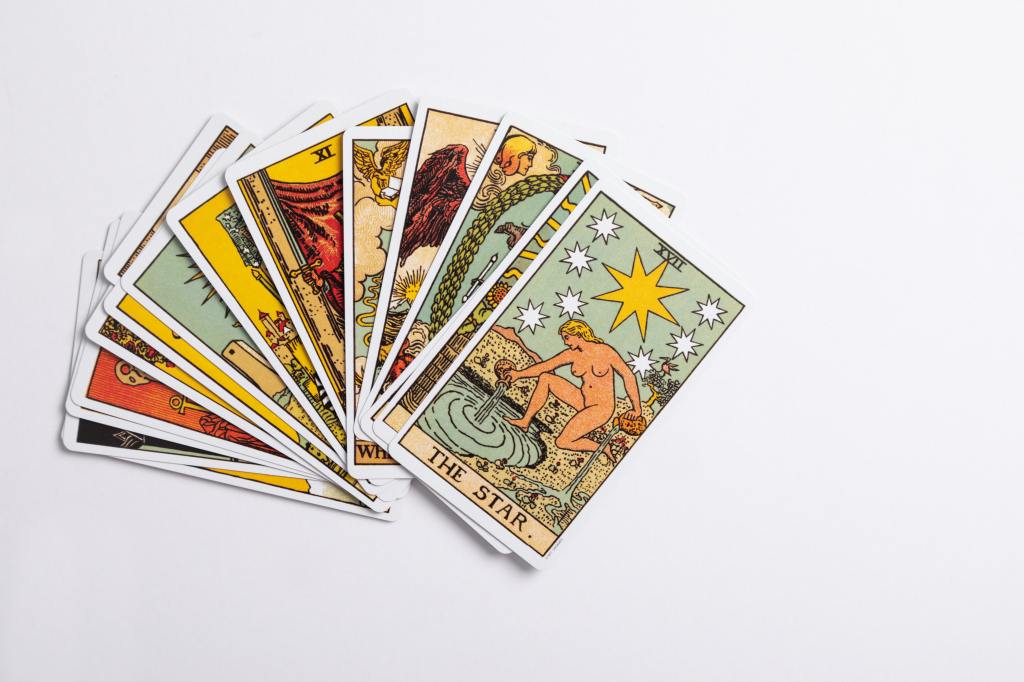
“Your vision will become clear only when you can look into your own heart. Who looks outside, dreams, who looks inside, awakes”
Carl Jung
“It’s a bit hippie” commented a recent house guest as they were perusing my bookshelves and landed upon one of my books on tarot. Their comment slightly surprised me as a tad old-fashioned (not to mention critical). It got me thinking about my tarot practice and what meaning it holds for me.
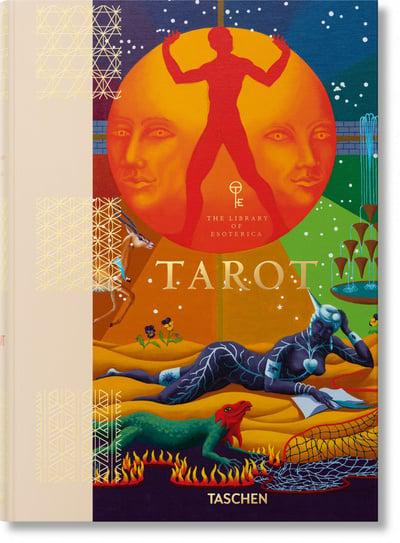
I began using tarot a few years ago, after my therapist recommended it as a way of checking in with myself (i.e., using the cards to wonder if their messages resonate for me personally). I am very much a novice reader; I currently have one deck (Rider Waite Smith deck) and only do readings for myself and not others. I attended a beginners tarot class (at the very lovely Treadwells in London) which helped me on my way and I often use a couple of websites to help me with my readings (these being Biddy Tarot and Labyrinthos).
Tarot, as well as other occult practices (e.g., crystals, witchcraft, moonology) have become increasingly popular in recent years especially amongst young women. Some commentators have said this is in response to the increasing turmoil in the world and us searching for meaning and connection to the divine or spirit world. These kinds of practices have become less about predicting the future and more as support towards self-exploration, including artistic pursuits and therapy.
The essentials
In brief, a tarot pack consists of 78 cards, 22 of them called the major arcana and the rest made up of four suits (Wands, Cups, Swords and Pentacles) called the minor arcana.
The major arcana is seen as the core of the deck and follow the journey of spiritual enlightenment and individuation from the Fool as card zero through to the World as card twenty-one.
The minor arcana provides more depth and detail around the major arcana and generally reflect day to day life. The four suits are often associated with the four elements (Wands: fire, Cups: water, Swords: air and Pentacles: earth). The minor arcana takes the more general themes of the major arcana and grounds them in the practical, everyday world.
Jung, Archetypes and tarot
Tarot cards, especially the major arcana, are said to hold archetypal significance. Archetypes, a notion devised by Carl Jung, are mental images found to exist in the collective unconscious. Well known archetypes include the hero, the joker, the rebel and the lover. The major arcana includes such cards as the lovers, the emperor, the fool, and the devil which correspond to archetypal figures. Reading tarot therefore brings elements forward from the unconscious into our awareness (much like how therapy operates at its basic level).
Jung had an interest in tarot at certain points in his life, speaking about the practice in a seminar in 1933 alluding to the card’s symbolism regarding individuation (a concept he devised about how a personality becomes stable and whole). Jung said that the cards “combine in certain ways, and the different combinations correspond to the playful development of mankind.” I like Jung’s inclusion of the word “playful” as it’s often how I treat my tarot practice; I enjoy exploring my readings but don’t take them too seriously.
My personal take
For me, my tarot practice has opened up another dialogue with myself (in addition to journaling and meditation) and allowed me to explore my intuition as well as touching upon the mystical and spiritual side of my life. Before I pull the cards from the top of the shuffled deck, I ask them a question, so my reading is more focused and hopefully easier to interpret.
I often use the cards to wonder what qualities I might need to draw upon for the day ahead and some of my readings have been spookily relevant. For example, I drew the Tower card (a major arcana) on New Year’s Eve for 2020. The Tower card in brief represents massive change, upheaval and chaos (er a global pandemic anyone)?
The cards sometimes have given me that extra push I need to move along with my life and have often shown up parts I might be trying to avoid (how annoyingly helpful)! Recently, the cards mirrored my fear of moving on from a certain situation and what I might be blocking by remaining in limbo. In this instance, I listened to the cards and took action and within a matter of days, positive, new experiences entered my life.
I hope I’ve challenged the negative “hippie” vibe that sometimes still exists around the practice of tarot and inspired a bit of curiosity. So maybe pick up a deck and give it a go (this is a lovely little video if you’re getting started). Explore, play and have fun!
Photo by Viva Luna Studios on Unsplash
 Suzie Chick
Leave a comment