
Hello all!
It’s that time when I delve into my ever-growing personal library and review four books which I hope you might also enjoy.
Hour of the Heart by Irvin Yalom

Irvin Yalom the prolific writer/existential psychotherapist is now in his mid 90’s, with his memory fading fast he decides on a dramatic approach to his work with clients. He will see clients for a one session only, hence the title of this book “Hour of the Heart”. Each chapter describes a different session, the good, the bad and the ugly!
One of the potential ugly highlights was when he sent his personal notes regarding a very tricky client to the client themselves in error (opps)! I couldn’t help but physically recoil and grimace as I read that bit! Other sessions were less dramatic, but full of the kindness, curiosity, and openness I have always admired about the author and therapist.
He was bolder than ever in these one-off sessions (knowing he only had one hour to help) and he often turned the table on his clients (who were often in awe of him) to ask him a question to dissipate the power dynamic which can exist between therapist and client. This invitation and self-disclosure often reinvigorated the session and led to a deeper level of connection.
The book is what we come to expect from the master of putting therapy to paper, though I will say I found the chapters at times a bit repetitive and perhaps a few could have been omitted from the final submission.
It is in the last chapter where Irvin focuses on himself and his declining memory and old age. He was incredibly honest about his thoughts of suicide especially against the backdrop of grieving the loss of his wife of 65 years, Marilyn, while writing this book and his decline into dementia.
Overall, the book is a solid and honest discussion of therapy, and I particularly enjoyed the reminder that great things can happen in just one session.
Arrangements in Blue. Notes on love and making a life by Amy Key
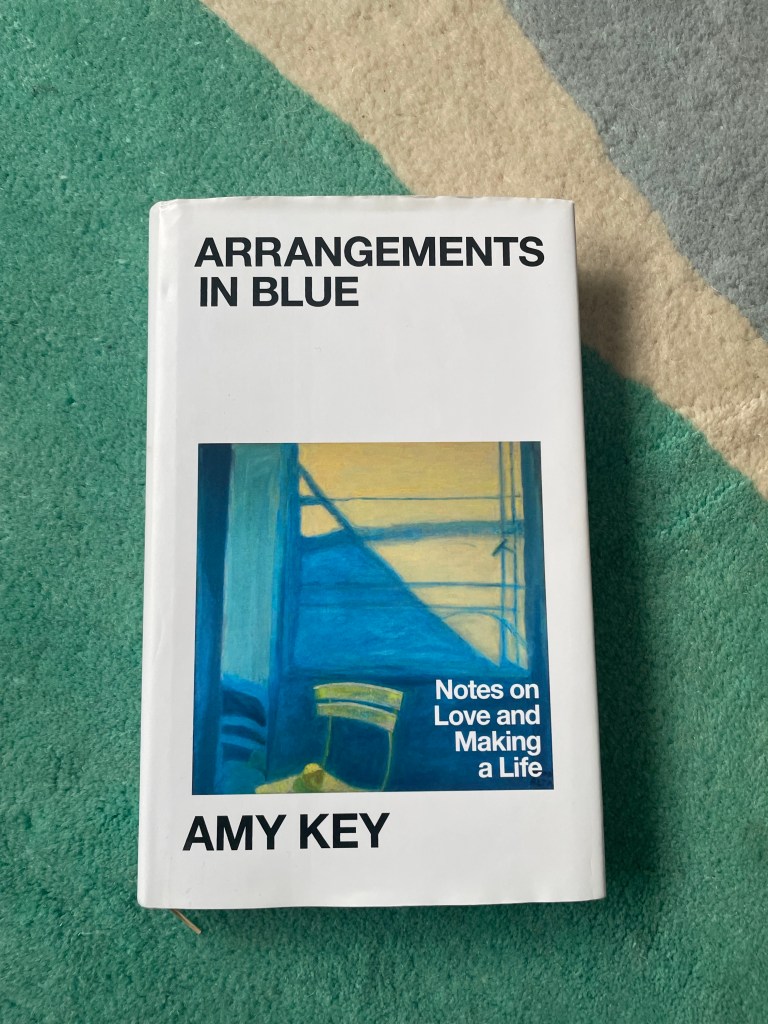
I have a confession to make, I bought this bought purely based on the cover and the sub-title. The concept of making a life in the absence of a romantic love inspired and intrigued me. This book is a deeply personal memoir of the author’s experience of love both intimate and plutonic in her early 40’s.
Amy’s experiences, both painful and joyful, deeply resonated for me and my own rocky journey of love and relationships. Amy uses her skills as a poet to great effect to describe the yearning for deeply intimate love and connection and coming to terms with its current elusiveness. Amy writes “I can want romantic love at the same time as valuing and being fulfilled by what is present in its absence.”
She weaves in the work of Joni Mitchell, demonstrating the artist’s struggle with intimacy and its expression through creativity. She writes tenderly and with such courage on the fading possibility of motherhood. One paragraph which has stayed with me:
“When I grieve not having a child, I want to remind myself those feelings pass; I want to let myself feel what I feel without attempting to tidy those emotions up into neat resolutions. Though I did not act on my body’s temporal utility, I retain my own powers of creation.”
I am so glad I initially judge this book on appearance as it’s one I have returned to several times already for its beautiful language describing what it often so difficult to put into words. Her story is one of acceptance and appreciation of what is. It’s an important reminder that whilst we yearn (and maybe moan) for what we don’t have in our lives, we might miss out on the joys of the present.
This Ragged Grace by Octavia Bright
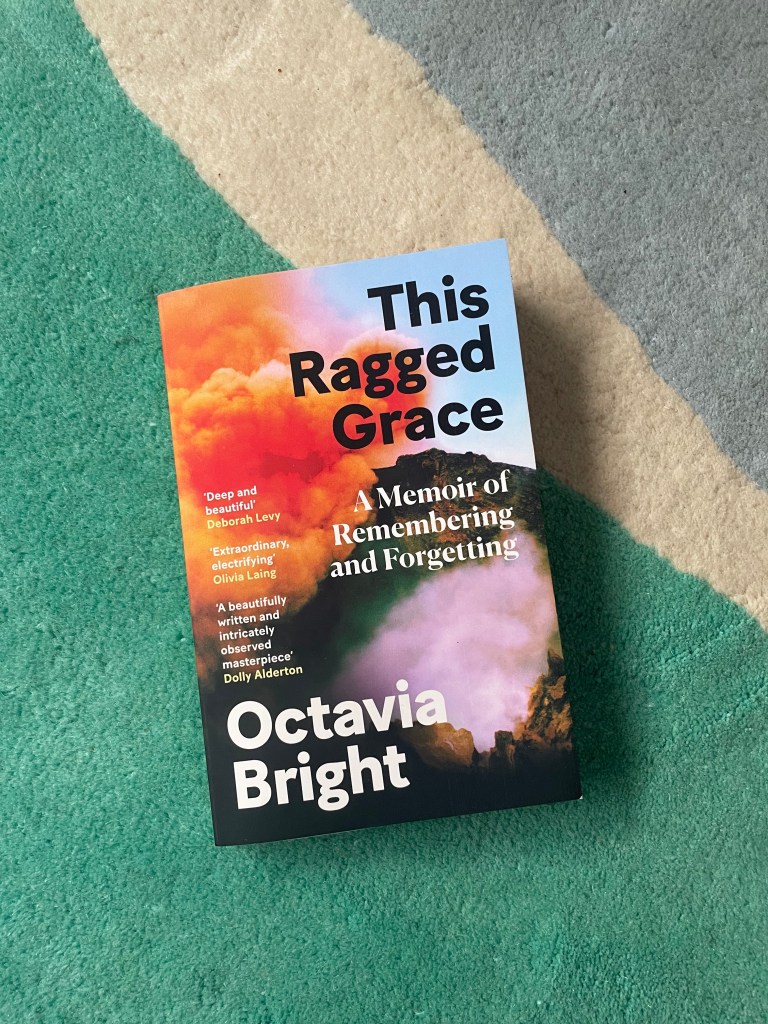
The author, a recovering alcoholic, wrote this honest and brave memoir telling the story of her seven years of sobriety whilst her father slips under the cruel spell of dementia.
Octavia writes with brutal honesty of her addiction, describing a massive wake up moment of badly injuring herself in a motorbike accident. She explains that “addiction is not about feeling good, it’s about not feeling terrible.”
Throughout the book, Octavia shares with us her growing knowledge and understanding of not just herself but also some of the fundamental theories used to understand our psyche, including Jung’s concept of archetypes or his concept of the puer (the eternal child).
As a reader, I found myself in awe of her progress, defending off her inner critic (who she names Wormtongue (a character created by Tolkien)) and the many external temptations which came her way especially as a means to escape the painful reality of her father’s illness. I especially enjoyed reading about her experiences of walking in nature, becoming more present and appreciating the strength of her new body (fuller and stronger after years of self-harm).
This is a truly intimate and honest account of both remembering (through the author’s recovery) and forgetting (through her father’s illness) and one I would highly recommend.
Burnout- how to manage your nervous system before it manages you by Dr Claire Plumby
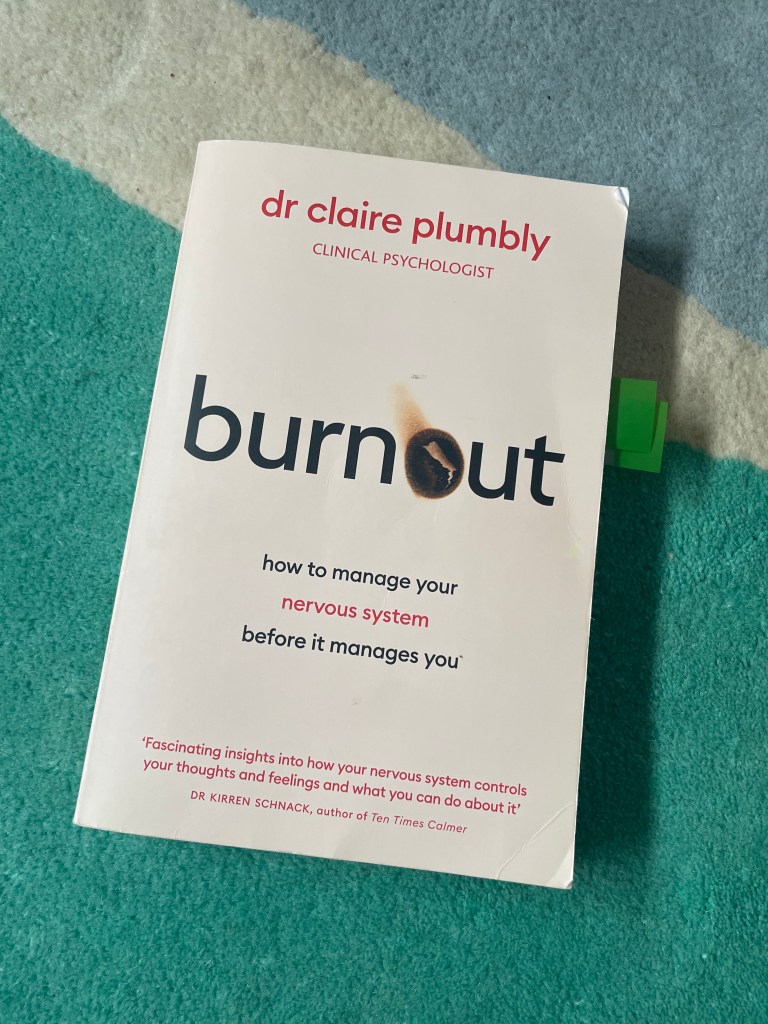
As some of you may know, I have a special interest in burnout having suffered with it myself in my early 30’s. And so, I was very keen to read Dr Plumby’s book. I was especially interested as the book draws upon polyvagal theory and compassion focused therapy, (elements where my knowledge is limited) as well as the author’s 20 plus years of experiences as a trauma therapist.
The book lays out the theory and the practical really well, using case studies to illustrate what burnout looks like and its impact. Claires writes clearly, using wit and a personable style which instantly makes you feel less alone with burnout (something which can be a real issue).
I really appreciated the tables which Claire includes explaining how to move between the gears of red, amber and green (those of polyvagal theory) which we experience in our bodies when under stress (for example the red gear being relevant to the fight/flight response).
I also really appreciated Claire’s discussion about perfectionism, people pleasing and avoidance of difficult emotions and how these ways of being play a role in someone experiencing burnout.
I did struggle a bit with the chapter on Compassion Focused Therapy (CFT) having to reread parts to get a full understanding but that might be due to my unfamiliarity not necessarily about how it’s been explained by the author. I also found some parts a bit limited in their coverage, such as the brief discussion on attachment styles but I can also understand that the book would be several volumes long if you tried to include everything! Such is the size of all thing’s burnout.
This book has become a regular resource for me when helping my clients with overwhelm and struggling to regulate the nervous system. It’s a bit of a burnout bible so to speak and one I would recommend not just for burnout but anyone experiencing chronic stress and overwhelm.
I hope some of my offerings this Summer have inspired. Happy reading all! Till next month,
Suzie x
Photo by Rachel Lees on Unsplash
 Suzie Chick
Leave a comment