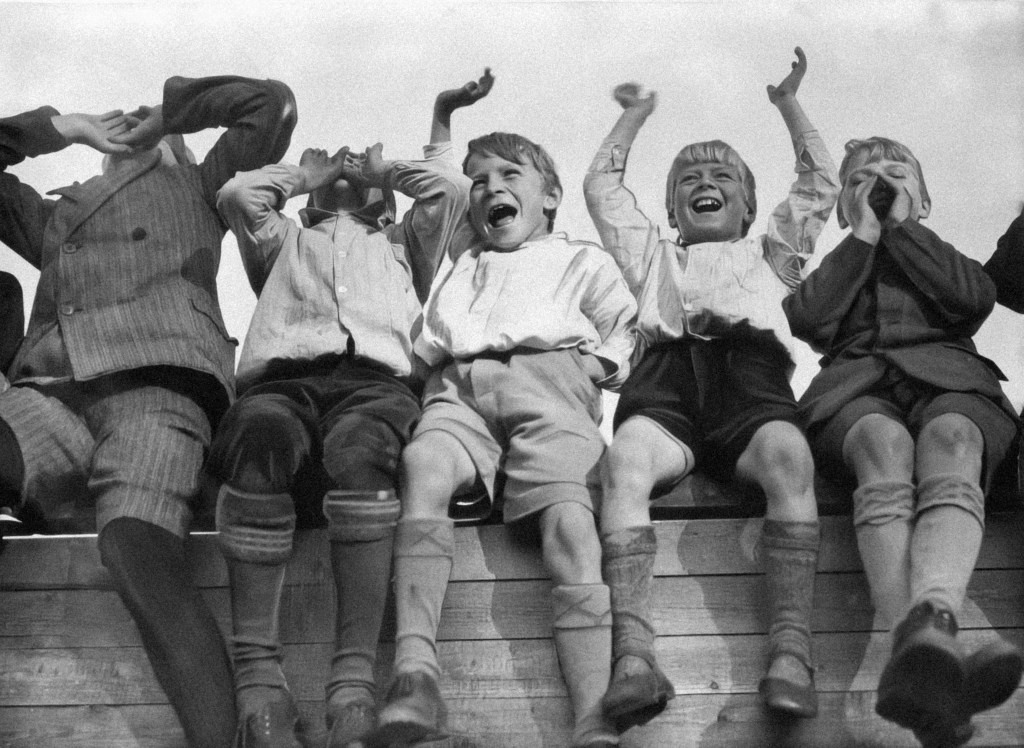
“Give me a child until he is seven years old, and I will show you the man” (Jesuit saying)
This month I am being a tad self-indulgent (why not hey?). I wanted to share with you a recommendation for a unique and brilliant British TV series called 7 up.
In 1964, World in Action made “7 Up” where they interviewed fourteen 7-year old’s (ten boys and four girls). The premise of the series was to examine the Jesuit saying of “give me a child until he is seven years old, and I will show you the man.” The TV series selected children from different socio-economic backgrounds to prove (or otherwise) that someone’s origins will determine their path in life. So, in other words, meet the child at seven years old and you will essentially meet the adult they will grow into.
The TV series revisited the participants (the willing and unwilling (after all who on earth can consent to being involved at seven years old?)) at seven-year intervals. This year, 2026, marked the final instalment with the participants at 70 years old. The final two episodes were aired recently, and so I wanted to share with you this amazing series and briefly consider a few of the participants and the possible psychological significance to their experiences.
A heads up before I proceed, there will be spoilers below, (you’ve been warned)!
Bruce – “an estrangement that was hard to overcome.”
“My heart’s desire is to see my daddy who is 6000 miles away”.
We met 7-year-old Bruce with these heartbreaking words. He attends a strict boarding school in Surrey with his parents separated and his father living in Zimbabwe. He appears shy and thoughtful through his teenage and early adult life. His father dies at 72, and Bruce reflects at 35 years old, “I would have liked to have got closer, to be able to miss him”. It’s clear to see the space left within Bruce, a father shaped hole. Bruce describes the relationship as “an estrangement that was hard to overcome.”
Ironically it was through the documentary series it seems that his father got to close the gap of connection and had told Bruce after seeing the instalment at 28 years old, that he was proud of his son.
In the last instalment of the documentary, Bruce reads aloud a poem written by his father while Bruce was young. The poem was accompanied by a photo of his father, both sent to Bruce when he was 7 or 8 years old. The poem and photo appear to have been kept from Bruce at the time. These items appear to have been only recently discovered. His father explains the photo is “so you don’t forget what I look like.”
The poem is tender and full of love and longing. His father clearly held Bruce in mind, all those miles away. I can’t help but feel sad that young Bruce may not have known this, and what it may have given him to experience such love. But equally how wonderful that he was able to discover this important artefact.
The poem ends…
“I claim that all the world shall know,
My son
My Bruce
A man.”
Bruce has framed the poem alongside the photo. It feels like something is reconciled at the end of Bruce’s story. The poem brings a remote father back to life and hopefully brings little Bruce some much needed comfort and healing.
Symon – “What you don’t have, you don’t miss.”
We meet Symon at seven years old living in a children’s home. He is the only participant from the Global Majority. As a young adult he describes the circumstances of being “an illegitimate child” and this being “something people only whisper about.”
He is asked as a young man what impact not knowing his father has had, he responds in the negative, explaining “what you don’t have, you don’t miss.” The understandable defences are visible, protecting him from the loss of a parent that never was.
Symon marries and has five children and explains that they have everything, “they’ve even got what I never had…a father”. He later divorced and we learn that the children have become estranged from him. There is the horrible risk of history repeating. A child who never knew his father, ends up becoming that himself when he has his own children.
Thankfully this is not where Symon’s story ends. He remarries and becomes a foster carer. As the years progress his children from his first marriage reconcile. At 70 years old, he explains that he and his wife have cared for over 130 foster children. He has been father to so many and thankfully not repeated history with his own children.
At 70, we find Symon reflective. He regrets not asking more questions of his mother while she was alive about his father. He knows nothing about him, and he explains “that’s a lot of big noughts.” He adds that he should not have worried about upsetting others, and wished he had asked more questions. A lesson so many of us need to hear also. One day it might be too late to ask.
Neil – “I’ve been kicking in mid-air the whole of my life”
We meet Neil at seven skipping along his road in Liverpool without a care in the world. He speaks confidently to camera explaining that he wants to be an astronaut when he grows up and if he can’t do that, then he’ll be a coach driver.
But then at 14 years old, Neil looks tired, his voice slightly strained. For me you can see a distinct shift. Neil is clearly intelligent, a thinker but he seems at 14 to have the world upon his shoulders. He appears riddled with anxiety, potentially triggered by academic pressure explaining that “I never have a time to relax at all”.
At 21 he has left university after a term and is living in a squat in London working on a building site. As the instalments progress, we witness the unravelling of Neil’s mental health, he becomes homeless at times, living an isolated and nomadic existence. It can be quite uncomfortable watching for me. The interviews of Neil seem invasive. At 35 years old he is asked if he is going mad, his response “I don’t think it, I know it.” Am not sure these kinds of interviews would be allowed in our current more compassionate and understanding times.
I don’t know what happened to Neil to cause the unravelling, I can only guess. I gleam from his early interviews that he struggled to launch into adult life and maybe did not meet the expectations of himself or his parents. At 21 he appears angry with his parents, “I don’t think I’ve had any stability… I think I’ve been kicking in mid-air all my life”.
At 42, living in the Shetland Islands, he explains “I don’t know where I’ll be in a month’s time.” Neil cites his religious beliefs as providing structure and meaning to his haphazard existence. There appears to be an absence of a constant object or secure base in his life. An absence of something to hold him steady, to sooth his distress and contain him. Neil himself cites that he wanted adventure in his life, to get away from the domestic suburban life of his parents but his early years growing up didn’t prepare him for it.
At 70, he’s retired to France, living a quiet simple life and is as happy as he feels possible. He advocates for mental health awareness explaining that a mental health condition “doesn’t mean someone is odd, it’s not something they choose, it’s what they are.”
Paul “when one of your parents are taken away from you, you lack security”
Paul, along with Symon, was at the same children’s home at seven years old. He was there due to a custody dispute between his parents. His Australian father won custody and took Paul back home and appeared to discourage contact between Paul and his mother. His father explained to Paul after he asked after this mother, “Your family starts and end with me”.
Paul admits to struggle with confidence all his life. As his wife explains in a later instalment, “when one of your parents are taken away from you, you lack security”. At 21 he contacts his mum and she visits him in Australia. He admits he didn’t recognise her at the airport. He admits at 21, he finds it hard to express emotion including telling his wife that he loves her. Paul appears timid at times, shy and lacking confidence.
There’s a moment in an interview with Paul and his wife, where she is asked what she loves about him, she replies “his helplessness”. Paul scoffs a little, as she explains that the mother in her makes her want to pick him up and cuddle him. I find it so wonderful that Paul has chosen a partner who really sees him and loves him for his vulnerability. She also adds in the same response that she finds him physically attractive, which I thought was a great way of making him into the adult, after such an insightful observation of his inner child.
In another interview, the couple talk about how they handle conflict. His wife explains in a row, Paul will often go to extremes and challenge her to leave him. This type of defensive reaction is so common amongst people with low self-esteem. The prospect of a conflict is enough to send them spiralling and fear the end of everything, instead of someone with good self-esteem who can tolerate disagreements and know they can be managed and survived.
Conclusion
As you can probably tell from my writings above, I find this unique series endlessly fascinating. I’ve only briefly explored four of the participants above, all fourteen of them are worthy of time. I find such richness and privilege in watching a person’s life unfold, not dissimilar to my work as a therapist. The series was an exploration of class and privilege, but for me it has so much more to offer about relationships with parents, family and most of all, ourselves.
And so, what about the hypothesis of the entire series, “Give me a child until he is seven years old, and I will show you the man”? I feel one the participants, Sue explains it best, “you can born shy, you can born extravert, that’s in you and then life happens”.
Thank you for indulging me in one of my all-time favourite documentaries. I hope it’s inspired you to take a look.
Way to watch
A little note for my readers….
A heads up that my posts here will change from monthly to every quarter to make space for a few other projects and interests.
So, I’ll wish you all a safe and restful festive season and I’ll see you in the new year!
Photo by Nationaal Archief on Unsplash


Leave a Reply