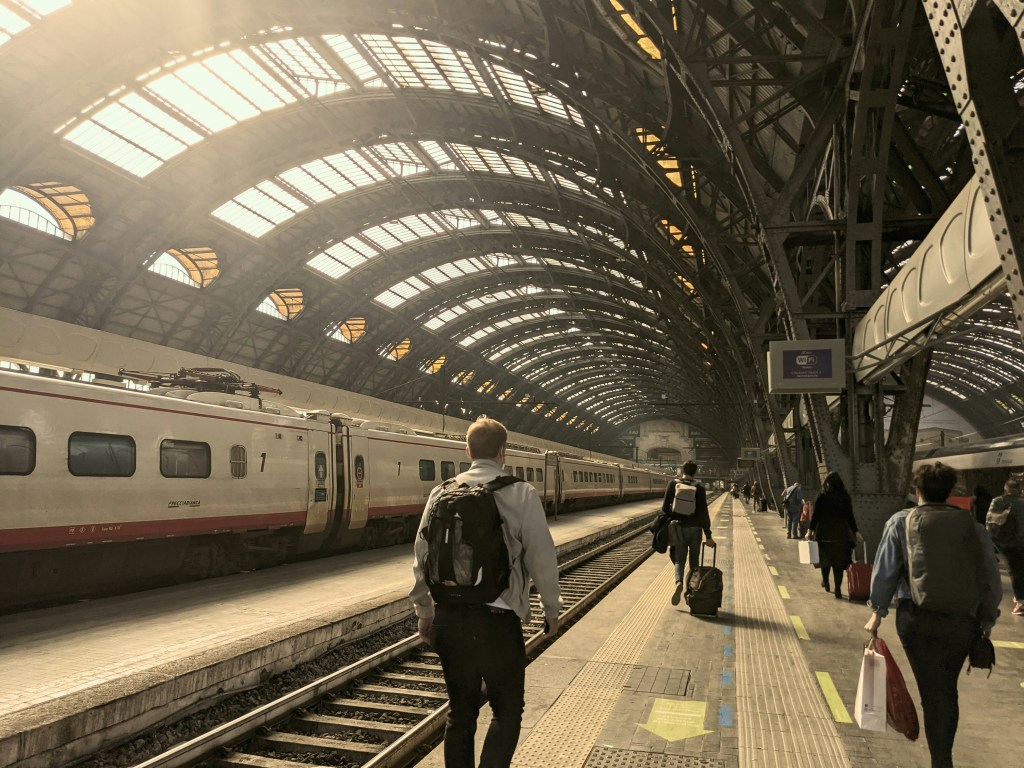
I thought this month I would share with you an experience I had recently, whilst travelling by rail, and talk through the possible psychological meaning behind it.
So, I am about to board a train for a short shuttle ride. The train before mine heading into the big smoke that is London, had been delayed and passengers had been advised to board my train as a part solution. And so, these slightly weary London travellers got on my little shuttle, with bags and laptops in hand.
One such traveller was a middle-aged woman. The moment she entered the carriage I could sense her stress. She was laden down with an awkward wheelie suitcase and a laptop (she was clearly mid work while she searched for a suitable place to land). She hurried past me and through to the next carriage only to return a few moments later and sit directly behind me. I heard deep sighing and some mild swearing not so quietly muttered under her breath.
Her stress was not only audible but also palpable. Her indecision to find a seat, for me, exemplifies her struggle to think clearly. Her darting through the carriage only to return. The energy wasted most likely only adding to her stressed out state.
Transference
I noticed very quickly that I began to take some deep breaths and readjusted my posture to ensure both feet were on the ground and my seated posture was straight. Her stressful energy was already impacting me. She was in essence, unconsciously, transferring her stress and anxiety onto those around her, including me. And like a vessel I was picking up her feelings and getting a bit stressed myself. I was having to take deep breaths and ground myself in order to shake off this woman’s way of being. If I had taken on this stressed state and acted upon it (say I become irrationally annoyed at something or someone) then that would be counter transference.
Window of tolerance
We stopped at our next station. Two women got on, clearly friends and sat in our carriage. They chatted loudly and were quite jovial (despite one of them apparently attending court later that day). For me I found their chat (which you couldn’t help but overhear) a light relief to the stressed woman behind me. But I could guess the impact of their behaviour was not going to go down well with my fellow passenger. The huffing and puffing and slightly louder swearing continued behind me as she tapped frantically on her laptop. I thought at one point she was going to get up and ask the other passengers to be quiet (we weren’t in an assigned quiet carriage by the way), but she didn’t. Instead, her noises from her seat behind me just got louder and louder.
It was clear to me that this stressed-out passenger was struggling with their window of tolerance. This is a concept devised by American psychiatrist Dr Dan Siegel, which describes the ideal emotional zone to feel calm and safe compared to feeling anxious or scared where we might experience fight or flight mode. In our window of tolerance, we can cope and manage when things go wrong. We can think clearly and mange difficult feelings. My sense with my fellow passenger is that her window of tolerance was at this present moment very narrow. This is shown by her strong negative reaction to the chatty women. When our window of tolerance is narrow, small niggles which we would normally take in our stride suddenly become very bothersome and irritating.
Conflict
Instead of a confrontation between fellow passengers, the actual conflict came in the from the guard checking our tickets for travel. The two loud women had not bought tickets, and one tried to justify it while the other agreed to buy hers. A slightly comical disagreement was had between the guard and the two women which was thankfully all resolved in the buying of tickets. Clearly our guard was no push over. The conflict though had added some extra energy to our already pretty full carriage (full in terms of tension not people). I could sense my stressed passenger behind me getting more and more agitated as the ticket row progressed.
There was another fellow commuter in our carriage, also a casualty of the cancelled London train, also with his laptop in hand, tapping away. He asked the guard how best to get to London from our train and the guard advised him. The guard checked my ticket and then headed to the hot seat behind me.
The guard was meet with an angry passenger complaining about the cancelled train and that she had an important meeting to get to and now would be late. The guard apologised but did not submit or fawn. He did explain that our local rail network was old and that due to this delays were inevitable. This did nothing to calm the woman down.
Managing uncertainty
Essentially for me, the guard was trying to say, “these things happen sometimes” and that the stressed commuter needs to accept this. Of course he had a point. Sometimes things do not go according to plan. Sometimes bad things happen. Sometimes good things happen. Sometimes things happen that are entirely out of our control, and we just have to adjust and adapt. Accepting uncertainty in life and that we can’t control outcomes can be a source of great anxiety,something I felt my fellow stressed commuter was exhibiting.
Panic stations
The guard’s Buddhist like response did little to calm the commuter. In fact, it seemed to only upset her further. She was not, in my opinion, able to access calm and rational thinking at this point (she had been too stressed for too long) and so being told “it is what it is” (essentially) was not received well. In my opinion, this commuter was in fight or flight mode, hence her panic and anxiety. In this mode, our pre-frontal cortex (located at the front of our brain) shuts down and our amygdala gets activated sending out distress signals. Our prefrontal cortex is often described as “the CEO of our brain” as it is responsible for decision making, planning and self-control as well as other cognitive processes. So, when the guard is trying to explain the situation, he was asking the stressed commuter to consider the situation thoughtfully and this just wasn’t in her current capacity given her stress.
Defensive strategy
She continued to moan loudly, the rest of the carriage, including the chatty women, were silent. Her voice was strained and I sensed she was close to tears. She moaned about the noise in our carriage, clearly aimed at the chatty women though not explicitly said. For me this was a classic example of a psychological defence strategy called displacement. This defence redirects difficult emotions from the original source, to a less threatening one. She was angry, upset and in distress and was blaming others for it. When likely at the core was a sense of helplessness and fear about the consequences of being late for her important meeting. It was easier, and safer, to blame the chatty women or complain to the guard than tolerate and contain her distress.
Fear of rejection?
The guard offered her to come with him. The woman quipped “what are you going to do?… throw me off the train?”. I found this question and assumption so interesting. I obviously don’t know this person at all so I can only offer ideas here. But what it suggested to me was an anxiety that the woman might hold about expressing her difficult feelings and being rejected (or literally ejected) as a result. A belief that if I speak up, am vocal and angry, I will get rejected and abandoned. This is not an uncommon internal belief system especially amongst us women who are often told to behave and that their anger isn’t welcomed. Potentially this woman had caregivers who punished her, say with silence or being sent to her room, when she expressed something difficult or negative. I found her immediate reaction to his invitation so fascinating and for me it felt possibly quite revealing of how difficult her outburst that afternoon had been for her to experience.
The guard explained that his suggestion was to move her to a quiet carriage so she could work and focus. She quickly gets her belongings together, wheelie suitcase, laptop and all and follows the guard out of our carriage. As she exits, the chatty women shout “rude” after her and begin to laugh. I can almost sense a massive exhale from all of us as she exits. The other London commuter exclaims “she needs to chill out” and I added “to take a deep breath or two”. There’s laughter as we recover, not at the stressed-out woman, but in reaction to the tension that was created. A light relief to clear the air. We are all in that moment connected through our experience.
Heading for burnout
Our light laughter aside, it felt to me that the stressed commuter was close to the edge of burning out. To get that upset about a delayed train was really saying something about her state of mind and wellbeing. As someone who’s been there myself, I felt great empathy towards her. And although I wasn’t able to connect with her during her brief time in our carriage, I hope that she is able to take some deep breaths very soon.
Photo by Jonathan Ansel Moy de Vitry on Unsplash


Leave a Reply