
Attachment theory is a key aspect of psychotherapy work, and one which I often consider with my clients, so I thought this month I would cover some of the basic features. I find knowing our style of attachment especially in close relationships to be invaluable in helping to build and maintain strong connections with others.
In short, attachment theory describes how the bonds we form as children with our caregivers shapes our emotional wellbeing and relationships with others.
The founder of attachment theory was John Bowlby whose work has had a significant impact upon social policy. Bowlby was brought up with five siblings and distant parents, which undoubtedly must have inspired his work in later life.
Why is this useful?
A third of the population of Western Europe and North America is estimated to have experienced some form of early parental disappointment. This disappointment leads to defences being created in order to ward off distress and anxiety. This then leads to problems trusting others and disrupting close relationships.
Knowing how we attach to others and how we cope with separation will reflect how we were cared for when we were young and help us understand ourselves better in relationships as an adult.
As always with self-exploration (often conducted through therapy), if we become conscious of how we attach and manage relationships, then that awareness gives us the choice to do something different, rather than play out the same old patterns of behaviour as they remain hidden in our unconscious.
The Strange Situation
Mary Ainsworth, Bowlby’s colleague and co-founder of attachment theory devised an experiment called The Strange Situation in the 1970’s.
In this experiment, a one-year-old child’s attachment behaviour was observed while their mother left them (for three minutes) and then returned and while an unknown adult was present and also absent. Watching how the child reacts, especially when the mother returns reflects their style of attachment. The aim is to ascertain individual differences in coping with the stress of separation.
It’s important to clarify that the relationship the child has with the caregiver is the focus in this experiment, not the child in isolation. It can be the case if you change the caregiver (say swap mother for father) you might get a different outcome in terms of attachment behaviour.
Types of attachment
Through Bowlby’s work and The Strange Situation, four types of attachment were identified. One being secure attachment and the other three being insecure attachment.
The table below lays out the four types, what can be seen in The Strange Situation test and how these types present themselves in later life.
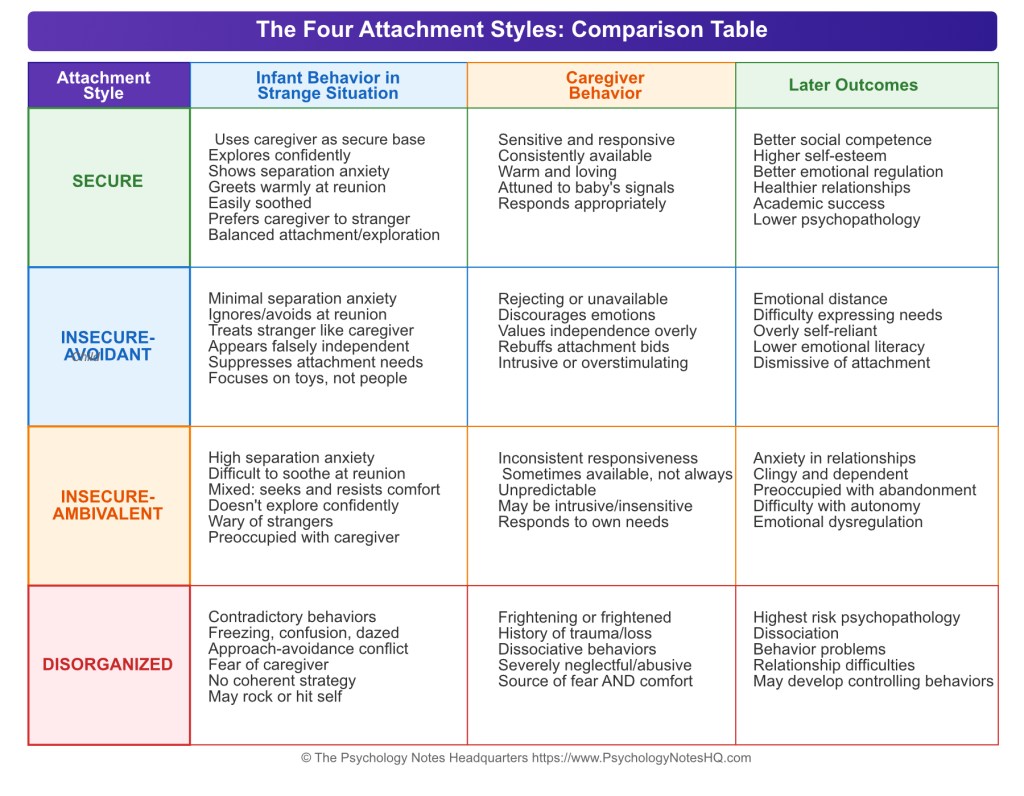
Just to clarify insecure ambivalent attachment can sometimes be described as insecure anxious. The anxiety around separation is more visible and demonstrated by the individual than compared to the insecure avoidant who on the surface often acts unbothered in such situations.
As you can probably gather from the table above, the disorganised attachment style is the most severe and can be found in individuals who have been brought up in abusive environments. Essentially in terms of The Strange Situation test, the child exhibits confused behaviours such as freezing when their mother returns. I think of it as if the child wants to go towards the mother for comfort but is aware of a risk that this reunion will not be positive (will I get a hug or a slap?) and so the child is full of doubt and confusion. Their caregiver can be a source of comfort but also one of fear.
In terms of the childhood environment for the two less severe insecure styles, I often differentiate them by explaining that the environment for ambivalent attachment was inconsistently responsive (i.e. sometimes the child’s needs were met and sometimes they were not). Whereas for a child to develop an avoidant attachment style, the environment growing up was consistently unresponsive (i.e. needs were rarely met).
Which one are you?
I wonder If you’re already working out which attachment style you lean towards?
One caveat is that this discussion focuses on intimate relationships not just our day-to-day interactions say with our postman or a neighbour. We focus on intimate relationships as they echo the relationships we had with our caregivers. They are high risk relationships; in the sense they involve high emotions and vulnerabilities.
So, for example you can have lots of securely attached relationships with friends, colleagues but with your partner you can be insecurely attached. Often insecure ways of being in intimate relationships only become evident in times of distress, for example if a partner is going away for a while or during an argument.
In my work I will often observe a client’s attachment style when they talk about their intimate relationships, their childhood experiences and at times how they attach to me as their therapist (that is not unusual).
A short questionnaire has been devised to help ascertain what style of attachment we have developed (devised by Hazan and Shaver 1987). Respondents are asked to consider the following three statements and decide which resonates most for them:
- “I want emotionally close relationships, but I find that other people are often disappointing or mean without good reason. I worry that I will be hurt if I allow myself to become too close to others. I don’t mind spending time on my own.
- “I want to be emotionally intimate with others, but I often find that they are reluctant to get as close as I would like. I worry that others don’t value me as much as I value them. It can make me feel very upset and annoyed.”
- “It is relatively easy for me to become emotionally close to others. I feel comfortable depending on others and having them depend on me. I don’t worry about being alone or not being accepted by others.”
You can probably work out which statement is which attachment style but just to confirm;
Statement 1 is avoidant attachment, statement 2 is ambivalent attachment and statement 3 is secure attachment.
I hope this general intro has been useful. I think a deeper dive would be even better, focusing on how we can address our insecure attachments to help us build healthy and adult connections. More to come, so watch this space.
Illustration by Centre for Ageing Better on Unsplash


Leave a Reply