
There’s a saying in therapy, that the large majority of the work we do with clients revolves around grief. Grief for someone who dies, a relationship that didn’t work out, a career that failed etc. But I also regularly come across a grief that remains hard to resolve. A loss that is and isn’t an actual loss. This is what’s called ambiguous loss, a term coined in the 1970’s by Dr Pauline Boss, an American psychologist.
Ambiguous loss refers not to an actual death or loss but something far more complex. There is no conclusion or proof of an actual death, but also no confirmation that the person or loss will return or be restored. There exists an incongruence between absence and presence. Examples of ambiguous loss include a loved own suffering with dementia or estrangement with a family member.
Two types
The ambiguous loss remains unclear. It’s a loss without resolution. Ambiguous loss is divided into two types, these being:
- Leaving without goodbye. When there is physical absence with psychological presence. Examples would include divorce, adoption or when someone goes missing say in a war or a natural disaster.
- Goodbye without leaving. When there is a psychological absence with a physical presence. Examples would include a loved one suffering with a lack of cognition/memory due to dementia or a brain injury or a severe mental illness such as chronic depression or addiction.
In a recent survey (June 2024) by Ambiguous Loss UK, a third of respondents cited estrangement as the most impactful and significant form of loss. And over half of respondents described their loss as traumatic.
This dominance of estrangement in the survey doesn’t surprise me as I have seen professionally an increase interest to go “no-contact” with specific family members. As someone who is estranged from a family member myself (by mutual choice), I remind my clients when estrangement is discussed that it is of course their choice to do so but to also be aware that estrangement does not mean the psychological presence of that person also goes away. Estrangement is a perfect example of ambiguous loss and a topic I have covered previously .
Ways to manage
As ambiguous loss is not an actual death, Dr Boss advises not to use a grief model (for example the five stages of grief) to assist but instead a stress management model.
Dr Boss has developed six guidelines to help manage ambiguous loss. She is keen to emphasise that the following six areas are all to be considered equally within a flexible process (hence the circular diagram below).
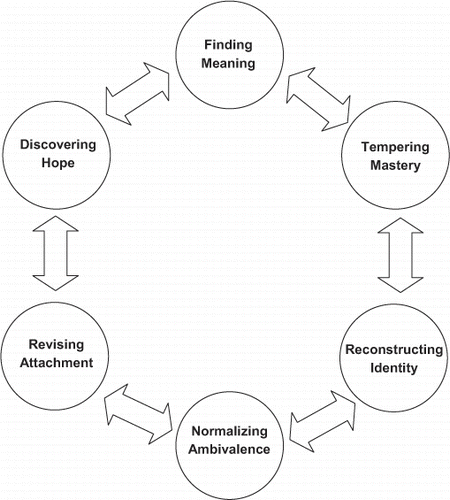
So, in no particular order, the six guidelines are:
- Adjust mastery – The key is to accept that we cannot control everything. We do not have mastery over everything. That sometimes bad things happen to us, and sometimes we can’t find solutions. Instead, we should focus and master one’s internal self (say through meditation), this being something which we can have choice and control over.
- Normalise ambivalence – Ambiguous loss asks us to hold two opposing concepts in mind and in our hearts at the same time. The person we care about has gone but also not gone. We need to become comfortable with holding two opposing ideas and still being able to function. We will feel a mix of emotions, often in opposition with one another. Normalising conflicting feelings can help us cope with ambiguous loss. Talking about how we feel to a good friend, peer group or therapist can help a great deal.
- Find meaning – The 2024 survey mentioned earlier found that over 90% of respondents experienced benefits from understanding and naming their experience as ambiguous loss. This identification can be part of finding meaning to the loss being experienced. Various research studies have shown time and time again, that those who find a sense of meaning to difficult experiences, recover better than those who don’t. Religious beliefs can be an aspect of this.
- Revise attachment – With ambiguous loss our loved one is both here and not here, gone but not gone. We need to let go whilst remembering. This isn’t about detachment but a revision of our relationship with the person. We need to hold our relationship in a new perspective, as opposed to separating. We celebrate what we (still) have whilst mourning the loss. The concept of continuing bonds (devised in 1996) can be helpful. This explains that just because a person has died or in the case of ambiguous loss has left us in some way, our relationship with them does not end, but it continues.
- Reconstruct identity – Experiencing ambiguous loss inevitably changes who we are. Part of managing this experience is to allow our identity to be reconstructed. Staying rigid often causes any pain relating to the change to be more profoundly felt. Can we adapt, allow the experience to change us. Can we try new experiences. Can we revise our role in the family for example and put down boundaries where needed.
- Discover new hope – By definition, we are required to become more tolerant of ambiguity when confronting ambiguous loss. This type of loss is not about closure but about ambiguity. We can build up our tolerance by trying new things and acting more on spontaneity than routine. Discovering new hope in our lives, be it through faith or spirituality or our connection with nature (for example), can help us feel more in control of our lives and feel more positive about the future. Allowing ourselves to have hopes and dreams can help us navigate the choppy waters of ambiguous loss.
Ambiguous loss is an incredibly complex loss to experience, and I don’t feel it’s talked about enough. It asks us to live in a world where two opposing concepts can be true at the same time. As the founder of ambiguous loss, Dr Pauline Boss, describes, “I intentionally hold the opposing ideas of absence and presence, because I have learned that most relationships are indeed both.”
For further resources
Photo by Samuel Ramos on Unsplash


Leave a Reply